
Unspoken Wings: How Penn’s Bird Speech Rewrites Rito Lore in Tears of the Kingdom
The Legend of Zelda: Tears of the Kingdom reveals the Rito species' innate ability to communicate with birds, reshaping avian lore.
The skies of Hyrule have always been a domain of mystery, but few discoveries have reshaped our understanding of its feathered inhabitants quite like the subtle yet profound detail embedded within The Legend of Zelda: Tears of the Kingdom. While Link traverses stables in pursuit of the ongoing “Potential Princess Sightings” rumor mill, the journalistic Rito named Penn offers more than just a quest progression—he inadvertently unveils an ability that recontextualizes the entire Rito species. The moment Penn casually leans in to listen to a chirping sparrow, then translates gossip about Zelda’s whereabouts, a door swings open to an entirely new layer of avian lore that continues to captivate scholars and fans alike well into 2026.

The sheer ordinariness with which Penn gathers news from actual birds is what makes the revelation so staggering. At first glance, it might seem like a quirky character trait—after all, he is a reporter chasing tabloid leads. However, the scene repeatedly demonstrates that the birds are not simply trained messengers; they are voluble informants relaying complex narratives. Penn’s beak, rather than being a barrier to speech, becomes the physiological link that enables this interspecies communication. The Rito’s very name, rooted in the Japanese word tori (bird), hints at an intrinsic connection. Unlike Hylians who perceive only a cascade of tweets, Penn discerns structured language. This implies that the Rito vocal apparatus is uniquely adapted to both Hylian phonetics and an entire spectrum of avian chirps and warbles—a biological duality no other species in Hyrule possesses.

Linguistically, this opens a treasure trove of ornithological insight. If Penn’s talent is not an isolated gift but a latent trait shared by all Rito, then the skies above Hyrule are actually buzzing with a second layer of discourse. Every sparrow, cucco, or hawk could be a potential informant, making Rito Village the most omniscient settlement in the realm. One can imagine fledgling Rito learning bird dialects alongside Hylian, their beaks capable of modulating from crisp consonants to fluid trills. This evolutionary divergence from other races—particularly the aquatic Zora, their supposed ancestral cousins—signifies that the Rito have not merely evolved wings; they have assimilated into the avian ecosystem on a cognitive level, becoming truly airborne both in body and in language.
This stands in stark contrast to the Rito first introduced in The Wind Waker. That earlier incarnation, still partially humanoid with taloned feet and beaked faces, required the blessing of the dragon Valoo to obtain flight-worthy wings. They were a people caught between ocean and sky, their Zora origins still palpably close. In Tears of the Kingdom, however, the Rito are born fully equipped for aerial life, a metamorphosis that is now underscored by their ability to communicate with feathered kin. Assuming the tangled Zelda timeline allows for continuity, this suggests that Penn’s generation represents the culmination of centuries of adaptation—a species that has shed every trace of its aquatic ancestry to embrace the sky in its most literal and intimate form.
Yet this charming detail carries an unsettling ethical undercurrent that has not escaped the notice of observant players. Link, as an omnivorous adventurer, can hunt and cook many species of bird—from hearty seabirds to fleet-footed plains fowl. If all these creatures possess the sapience demonstrated by Penn’s sources, then every drumstick roasted over a campfire suddenly becomes a morally fraught act. The inhabitants of Hyrule, including the carnivorous Gorons and even the Rito themselves (who are known to fish and eat poultry), appear utterly unbothered by this contradiction. This cognitive dissonance paints a world where interspecies communication exists side by side with casual predation, a paradox that the game leaves deliberately unresolved, perhaps mirroring the messy boundaries between culture and survival.
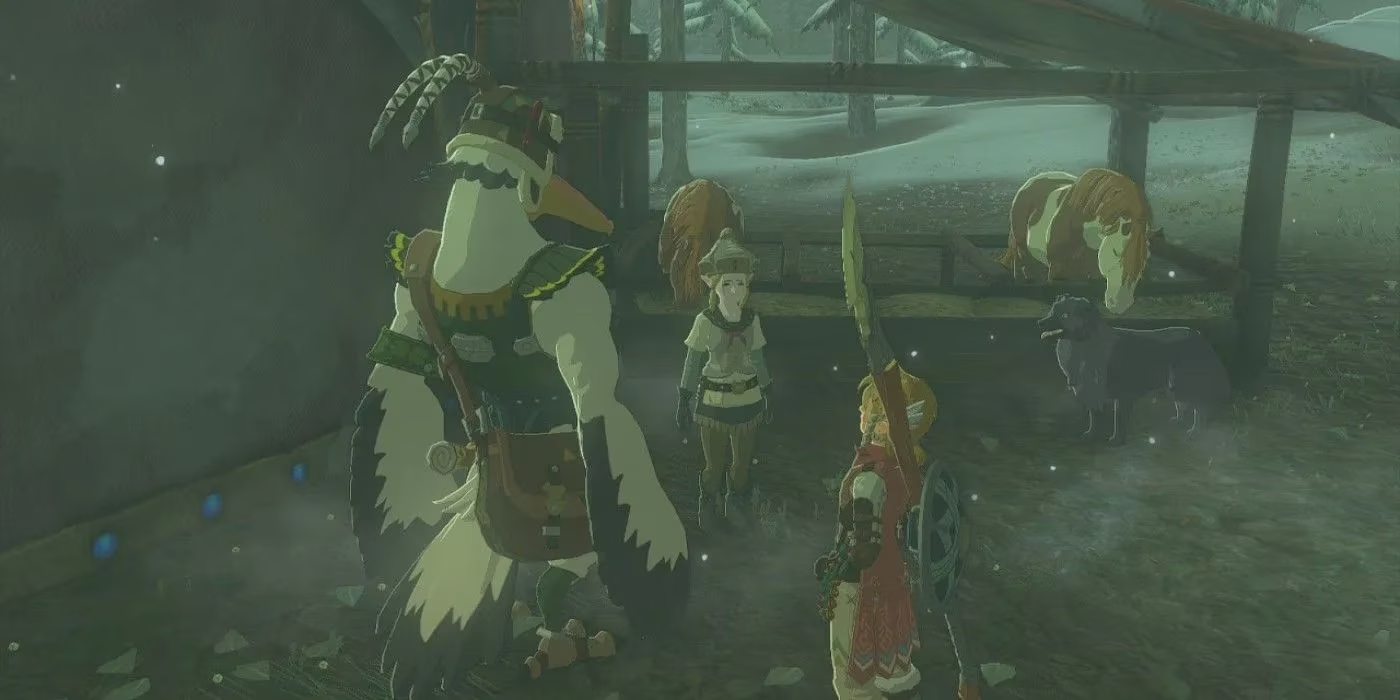
Tears of the Kingdom is hardly the first Zelda title to depict animals as unexpectedly intelligent. In Twilight Princess, Link’s wolf form allowed him to howl conversations with hawks and cats, leveraging their senses to unearth secrets—Louise the cat even guided him through sewers to save Midna. That precedent reinforces the notion that Hyrule’s wildlife has always occupied a gray area between instinct and comprehension. Penn’s ability thus fits into a broader pattern, but it also deepens it, because the Rito have institutionalized this connection. They do not merely speak to animals; they rely on a continent-wide network of winged informants that replaces the need for messengers, telegraphs, or Sheikah Slate notifications, effectively making the entire bird population an extension of their own society.
Ultimately, Penn’s casual bird-talk is a quiet revolution in Hyrulean anthropology. It transforms the Rito from simply a visually distinct race into a uniquely empistemic one—their culture built not just on wind currents and song, but on an information ecology that lets them chase down every whispered rumor with staggering efficiency. In 2026, as the Tears of the Kingdom community continues to peel back layers of lore, this tiny narrative thread remains one of the most resonant. It reminds us that the most groundbreaking world-building often arrives on feathered wings, and that in the skies of Hyrule, every chirp may carry a headline.