
Two Years on, My Korok Plushies Still Carry a Tiny Slice of Hyrule
The official Traveling Korok plush brings Tears of the Kingdom's backpacking spirits to life. Both variants capture their smile perfectly.
I still remember the first time I slipped on a patch of moss in the Great Hyrule Forest and tumbled directly into a hidden Korok. It was 2017, and Breath of the Wild had just taught me that the world is riddled with tiny, leafy spirits that giggle when you surprise them. That sound—like a wind chime made of acorn caps and spider silk—has followed me through dozens of returns to Hyrule. But nothing solidified my fondness more than the moment in 2024 when I ripped open a parcel from Japan and found myself face-to-face with two backpack-toting Traveling Koroks, stitched and stuffed, their fabric laughter somehow louder than the in-game chirps.
Back then, I was still waist-deep in the sequel. Tears of the Kingdom had turned Korok reunification into a new kind of obsession. Rather than simply lifting a rock, I was now strapping logs together with Ultrahand, building rickety wagons, and hauling one lazy Korok across gorges to meet its equally stranded buddy. The payoff was always a pair of golden seeds—a thank-you from two walking, talking puzzle pieces that had somehow gotten separated while backpacking. I used to think of them as woodland memory knots, like living treasure maps crumpled into the shape of a leaf, each one a tiny echo of the forest’s patience. Finding them felt less like completing a checklist and more like untying a story the trees had been trying to tell me.
By late 2023, word spread that Nintendo and Sanei Boeki—the same Japanese manufacturer that had given us plush Bokoblins and Pikmin—were producing official Traveling Korok plushes inspired directly by Tears of the Kingdom. Sanei Boeki announced the release on Twitter, promising two variants around mid-February 2024. The first was a richer, forest-floor green with a light brown backpack, dark brown base, and a sunset-orange bedroll. The second? A paler, almost sun-bleached green, with a bright red backpack and a mustard-yellow blanket. Both wore that oddly melancholic smile I’d seen a thousand times on my Switch screen. The dimensions were given in a follow-up tweet: 22 centimeters wide, 18.5 in diameter, and 17 high—the sort of palm-cradling size that makes you want to tuck them into your own rucksack. Each cost about 3,300 yen, or roughly $22 at the time, but the real cost was patience. No US retailer was confirmed, and my hopes of waltzing into a local GameStop were crushed like a Moblin under a falling boulder.
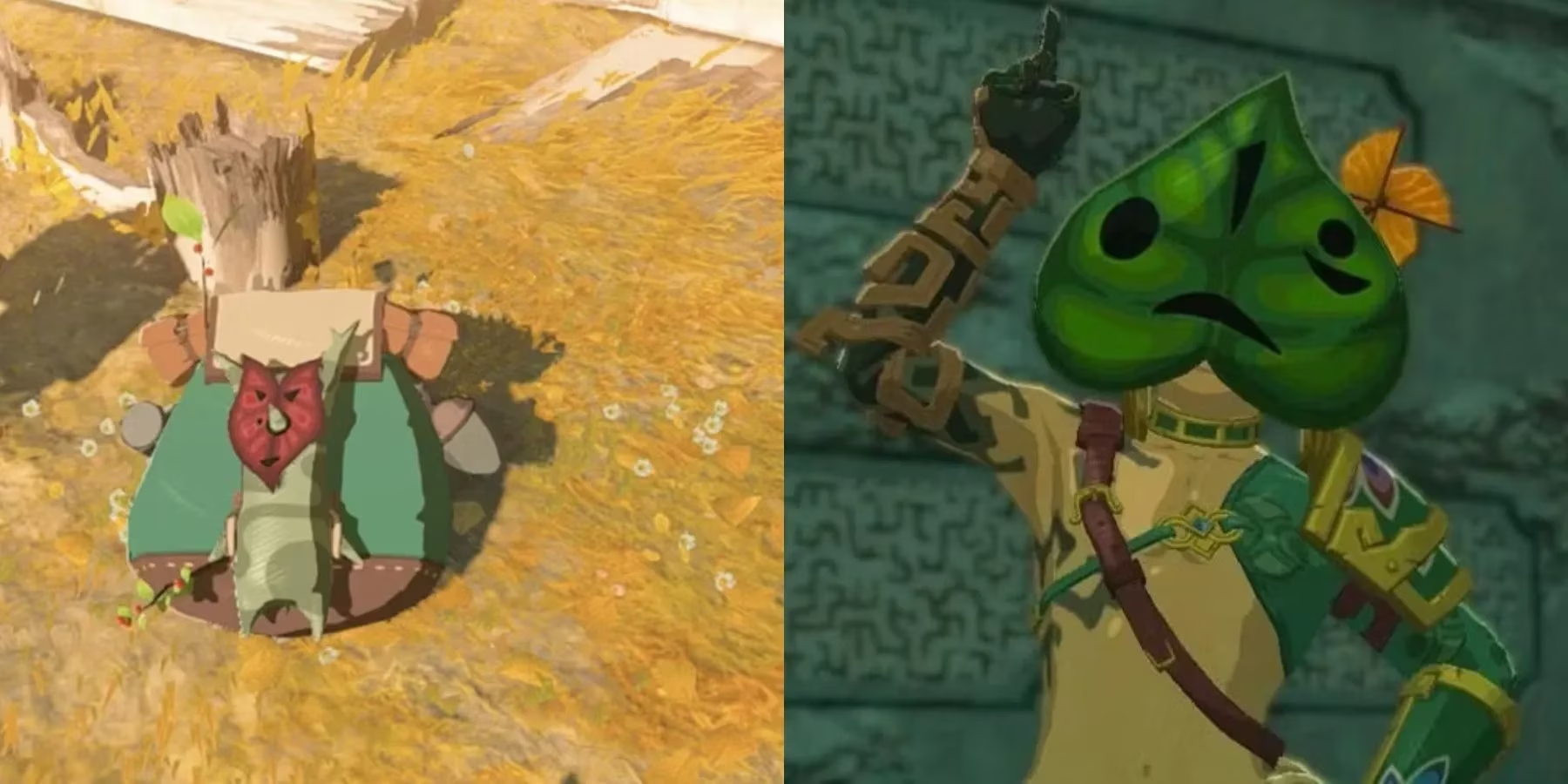
So I joined the legion of sleepless Zelda fans refreshing proxy-buying services. The plushies dropped in February 2024, and within hours my order was in: both variants, because choosing felt impossible. What followed was a six-week interval that felt longer than the wait for the game itself. I traced the shipment from Osaka to customs, imagining the little spirits bouncing inside a dark box like seeds in a gourd, their stitched backpacks gently nudging against bubble wrap.
When the package finally split open in my living room, the first thing I noticed was the texture—short, dense plush like the velvet on a deer’s antler, with just enough nap to make their bodies look mossy. The backpacks, as I’d hoped, were structured but soft, the straps sewn securely. The darker green Korok wore its brown pack like a tiny snail shell, a portable home that seemed to carry its entire forest within the stitching. The lighter one, with its crimson rucksack, reminded me of a traveler carrying a bundle of autumn leaves on its back. Their faces were embroidered with that characteristic leaf-shaped mask, and their eyes had an almost knowing squint—like they’d just enacted a prank that Link would stumble upon in three hundred years.
I set them on my desk between a half-built Zonai device Lego and a stack of game cases. Over the next few months, they became background companions during my late-night Hyrule sessions. Every time I completed a Korok buddy-reunion puzzle—often by launching a frightened Korok via rocket-powered sled—I’d glance at the plushies and feel an odd twinge of guilt. Here were the same little guys I’d just sent tumbling down a cliff, now sitting placidly beside my monitor, their fabric backpacks unburdened. It was the closest I’d come to a truce with the game’s most endearing collectible.
Now it’s 2026, and the Traveling Koroks have long since vanished from direct retail. They pop up on secondary markets at inflated prices, tucked between listings for discontinued amiibo and out-of-print art books. My pair sits in a custom acrylic case, the bedrolls still pristine, their colors undimmed. Friends who visit occasionally ask why I’ve displayed two plush mushrooms with leaves on their faces. I tell them they’re more than that: they’re physical fossils of a digital walking path, souvenirs from a Hyrule that keeps rewriting itself with each new DLC and mod. But the truth is simpler—they’re the most tactile reminder I have that even in a world of flashy sequels and photorealistic graphics, a tiny leaf sprite with a backpack can carry an entire forest’s worth of memory.
Here’s a quick breakdown of the two versions I snagged, in case you ever stumble across one at a convention or a retro game shop:
| Feature | Dark Green Korok | Light Green Korok |
|---|---|---|
| Body Color | Rich forest green | Pale, sun-bleached green |
| Backpack Color | Light brown | Red |
| Base/Bottom | Dark brown | Dark brown |
| Bedroll/Blanket | Orange | Yellow |
| Width | 22 cm | 22 cm |
| Diameter | 18.5 cm | 18.5 cm |
| Height | 17 cm | 17 cm |
I sometimes wonder if Nintendo ever intended these plushes to be exported widely. The lack of a formal US release made them feel like a secret only the most stubborn fans would uncover—yet another Korok puzzle, but this one required navigating international logistics instead of swinging a sword. And just like in the game, the reward was a small treasure that whispers, “You found me.”
Looking back, I think those two stitched travelers taught me something about how we connect with virtual spaces. Koroks aren’t heroes, they don’t progress the story, and they will never land a final blow against Ganondorf. Yet they embody the quiet persistence of discovery. Each plushie now sits like a cairn marking the spot where the digital and the physical worlds briefly touched. And when I press their bellies and imagine the faint yahaha! that doesn’t actually come, I’m instantly back in that forest, moss under my boots, another backpack-bound friend waiting just across the ravine.