
TotK Player Creates Laser-Barrier Hover Bike That Turns Hyrule Into a Killing Field
The Legend of Zelda: Tears of the Kingdom's Zonai hover bike gets a laser barrier via stake nudging, becoming Link's flying fortress.
In 2026, The Legend of Zelda: Tears of the Kingdom remains a workshop for players who treat Hyrule as a physics playground. Long after its initial release and following the arrival of the Nintendo Switch 2 Edition, the game's Zonai construction system still produces machines that feel equal parts practical and absurd. The latest example comes from Reddit user divlogue, an inventor who has transformed the community's favorite hover bike into a laser-wreathed instrument of battle. By surrounding the vehicle with spinning Beam Emitters, divlogue created a defensive barrier that also functions as an offensive weapon, slicing through Bokoblins as Link pilots the craft through enemy camps.
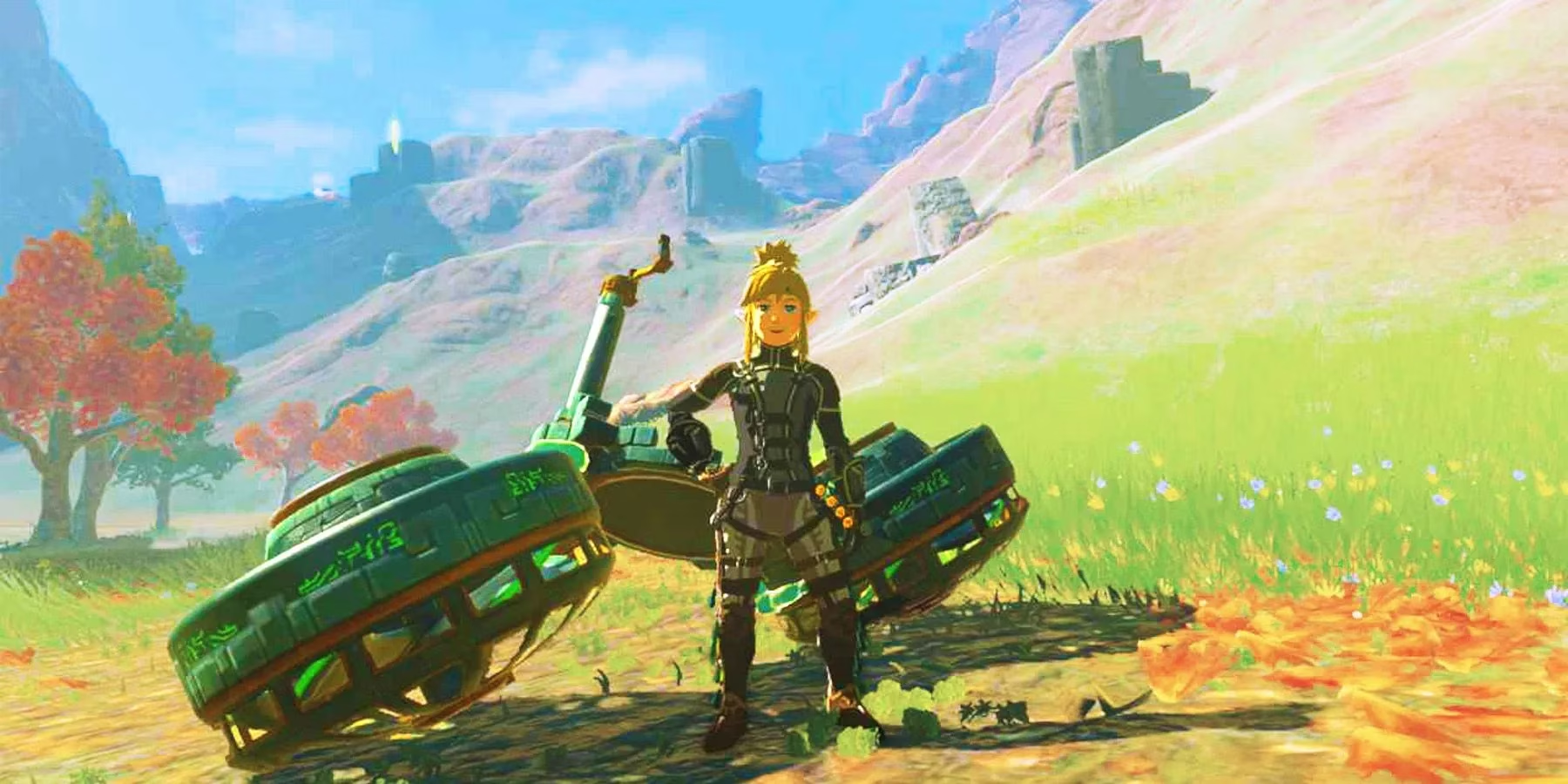
From Simple Hover Bike to Flying Fortress
The standard hover bike in Tears of the Kingdom is a model of elegant minimalism. It requires only two Zonai Fans and a Steering Stick. Players place the fans at angles that provide lift and forward momentum, attach the steering stick, and then use Autobuild to summon the machine whenever Zonaite is available. More ambitious builders add extra fans, adjust angles, and tune the bike for speed, stability, or carrying capacity. The hover bike has become the go-to vehicle for traversing Hyrule's skies, and it is often the first complex build that new engineers learn to replicate.
Divlogue's version, however, treats that simple chassis as the foundation for something far more aggressive. The craft is larger than a typical hover bike, and it bristles with Beam Emitters that float around Link at a distance. Each emitter aims downward, so when the vehicle moves, the lasers carve a rotating cage of light around the pilot. The effect is like a mechanical hedgehog whose quills are made of coherent light. Enemies that wander too close do not merely take damage; they enter a kill zone that travels with the bike.
The Secret Is Stake Nudging
The technical trick behind the laser barrier is a Tears of the Kingdom technique known as stake nudging. This method allows players to create invisible connections between two or more objects, effectively gluing parts together without visible supports. It is a patient, precise process. Divlogue mentioned that getting the design to work correctly took about 30 minutes, a testament to how finicky the physics can be. Once the Beam Emitters were properly spaced and connected, they could spin in the air around the hover bike, forming a barrier that looks impossible at first glance.
The result is a vehicle that behaves like a mobile thundercloud with a grudge. In the posted video, Link drives along the Tarrey Town Highway while the lasers rotate at high speed. The spinning emitters create a protective shell, and the bike becomes difficult for melee enemies to approach. The footage then cuts to Hyrule Field, where divlogue tests the machine against a group of Bokoblins. Link drives directly through the pack, and several of the weaker Bokoblins die almost instantly. In the final section, the hover bike rises high into the air above a cluster of enemies, raining down death from above. The machine has become a flying weapons platform, not just a transport.
| Component | Function |
|---|---|
| Zonai Fans | Provide lift and propulsion |
| Steering Stick | Gives Link control |
| Beam Emitters | Form the spinning laser barrier |
| Stake Nudging | Creates invisible connections that allow the emitters to spin |
| Autobuild | Lets the machine be reconstructed quickly with Zonaite |
A Builder With a History of Viral Machines
This is not divlogue's first unconventional hover bike. The same player is responsible for the President Hudson hover bike, a vehicle that used stake nudging to float four President Hudson signs around its diagonal axes. That build became a viral curiosity because it turned a mundane signage prop into a surreal flying monument. The laser-barrier bike continues that tradition: it takes a known technique and applies it to combat in a way that feels both clever and slightly ridiculous. As stake nudging becomes more popular, the Tears of the Kingdom community is likely to see even stranger designs, including vehicles that seem to violate the game's own rules.
Why the Laser Hover Bike Matters in 2026
In 2026, Tears of the Kingdom is no longer a new release, but its creative community remains active. The Nintendo Switch 2 Edition has given the game a sharper presentation and smoother performance, which makes elaborate Zonai builds easier to appreciate and record. Players still return to Hyrule to test contraptions, share videos, and refine techniques like stake nudging. The laser-barrier hover bike is a perfect symbol of that enduring appeal. It is not an official feature, a quest reward, or a scripted ability. It is an emergent invention, assembled from the same parts that every player can find.
The machine also highlights why Tears of the Kingdom continues to fascinate engineers and combat tinkerers alike. A hover bike normally solves a movement problem: how to cross a canyon, climb a cliff, or reach a sky island. Divlogue's version solves a combat problem at the same time, turning traversal into a weapon. The bike becomes a chandelier rebuilt by a warlord and taught to hover, beautiful in its geometry and terrifying in its purpose. For players who have already beaten the game, such builds are the endgame: a way to rewrite Hyrule's rules with nothing but Zonai devices, patience, and a willingness to nudge invisible stakes.
The Legend of Zelda: Tears of the Kingdom is available on Nintendo Switch and Nintendo Switch 2. As long as players can combine fans, emitters, and steering sticks, the boundary between vehicle and weapon will keep blurring, and the next impossible machine is only a few stake nudges away.
Recent analysis comes from GameFAQs, whose long-running player guides and community Q&A illustrate how advanced building methods in Tears of the Kingdom—including precise device spacing, stable hover-bike tuning, and combat-focused Zonai setups—can turn traversal tech into repeatable “blueprints” that others can troubleshoot, optimize, and recreate via Autobuild.